


Anyone who enjoys some sporting action might worry about not being able to see any when they travel. Yet, there are some great ways of doing so wherever you head to.
Here are some great ways to enjoy sports as you travel
Watch the Most Popular Local Sport

Going to see the nation’s favorite sport can be an unforgettable experience, especially if it is a huge event with lots of spectators. You will get to see how the locals react to the drama of the sport, and you might also learn to love a new type of game at the same time.
It makes sense to learn some of the basic rules and a little about some of the star players before you head to the event. Some sports can appear completely baffling if you watch them without really knowing what is going on.
Look for Wacky Events

The UK is a great place for weird sports. From cheese rolling to bed racing and from bog snorkeling to tin bath racing, there are plenty of strange competitions all around the country. People know how silly these games are, and they just exist to give everyone a bit of harmless fun.
As for some other sports, you should be careful not to be disrespectful when watching things that appear unusual to you. In Asia, you will discover fascinating games such as Sepak Takraw and Kabbadi. Also, the World Nomad Games, which covers disciplines like goat-carcass polo and horseback wrestling.
Meanwhile, Italy has the rugged Calcio Fiorentino: basically, soccer with no rules.
In England there is the Cooper’s Hill Cheese Rolling Run, where you are running after a cheeseball in the slope of a mountain: careful, it is more dangerous than it seems.
Join Others to Watch Your Favorite Sport

Another possibility is that you go to watch local teams playing a sport that you enjoy. This is a fine way of seeing the game in a different light. Will you see some upcoming stars that take your breath away or will you think that the standard of play is lower here than at home?
You might even find that this is a fine way to strike up conversations with other fans. A shared love of sports can bring together people from different cultures more easily than most other things could do.
By adding some sports to your traveling, you can turn any trip into more of an adventure. The first step is to take a look and see what your options are. Since sports are hugely popular all over the world, you shouldn’t find it too difficult to discover something that interests you.
Thanks for reading our article on some great ways to enjoy sports as you travel. Let us know in the comments if you have any tips you don't think we covered here.
Thanks for reading our article on some great ways to enjoy sports as you travel. Let us know in the comments if you have any tips you don't think we covered here.

In this article, I will go over different methods of learning on the go, the merits of combining travel with education, and some of my thoughts on the questions that alternatively minded parents have grown accustomed to hearing over the years.
An Introduction to Travel as Education:
There are plenty of different ways that traveling parents choose to educate or support their children abroad, and all of them are valid. Some families take comfort in having more structure, while others are fine with flexibility and spontaneity in regards to learning opportunities. Below are 3 main styles that I have identified, however, it’s important to note that there are as many unique educational styles in the world as there are individual families.
Homeschooling
Homeschoolers are those that choose to follow a curriculum whilst traveling. That being said, there are a few different types of homeschoolers, including Traditional Homeschoolers who tend to follow state or school-district approved curricula, and Eclectic Homeschoolers who mix and match their schooling materials, often incorporating their travel destinations as part of their study content. Families with children that strive with clear direction, discipline and structure tend to find some type of Homeschooling to be the best fit while traveling.
Self-Directed Learning
Also known as autodidactism and sometimes associated with ‘Unschooling’, proponents of Self-Directed Learning operate on the principle that learners should be empowered to seek out their own education and supported in their choices as a student. This method synergizes beautifully with travel, as exposure to new experiences and immersion in different cultures can spark interest in subjects such as history, science, economics, biology, language, and many, many others. This style of education is for those who thrive with a sense of freedom and can allow ambitious and eager learners to excel in their own learning process.
Traditionalism
Traditionalists believe in the merits of a structured, brick and mortar school setting, and will often seek out schools, classes, and courses in their host countries. Though in some senses this approach can be restrictive whilst traveling, there’s something to be said about it facilitating connections between your family and the local community, and is often viewed as a short-cut to meeting locals and forming bonds and friendships with them. Other benefits include a strong sense of cultural understanding (ie: doing what the locals do) and one of the best approaches to immersive language learning.
The Merits
Travel and education go hand in hand, with the union of the two making way for more integrated learning, personal growth, soft-skill development and shifting perspectives. When having a conversation about travel as education, It’s important to remember that not every classroom has four walls. Here are a few of the many notable merits that pertain to this rich and complex topic.
Relevancy
The proximity to subject matter when traveling tends to make the opportunity for learning more personal, ultimately resulting in a deeper and more gratifying experience. Students and learners who can see themselves and their relationship to the subject in perspective are able to recall information and knowledge with greater ease than those who may have simply studied the same topic from a static source. Travel tends to make things personal, and a student who has visited, experienced and related to a topic is more likely to understand it than someone who has only witnessed it second hand.
Experiential Learning
 Something similar can be said for experiential learning as well (or, to put it simply, ‘learning by doing’). Experiential learning is the oldest and most familiar method to mankind for knowledge and skill acquisition, predating the modern-day understanding of ‘schooling’ for thousands of years. This is something that is accessed commonly when traveling abroad. Some key examples of this are: doing volunteer work with local projects, budgeting, and planning and language learning through conversation.
Worldview and Cultural Awareness
Though the other merits listed above are also significant, in my opinion, this element is the most important one of all. By immersing ourselves in a new environment, travel allows us to change, adapt and adjust our perspectives and worldviews, (the way that we perceive the world) and by doing so allows us to better understand people from different backgrounds. This is one of the most important soft skills that one can learn, and there is no better way to pick it up than by the power of cultural immersion.
The Dreaded Questions

Worldview and Cultural Awareness
Though the other merits listed above are also significant, in my opinion, this element is the most important one of all. By immersing ourselves in a new environment, travel allows us to change, adapt and adjust our perspectives and worldviews, (the way that we perceive the world) and by doing so allows us to better understand people from different backgrounds. This is one of the most important soft skills that one can learn, and there is no better way to pick it up than by the power of cultural immersion.
The Dreaded Questions
These are the questions that every traveling parent knows you’re going to ask before the words even leave your mouth. They have all heard them a million times and will likely continue to hear them until there’s a better, general understanding of travel and education. Though there are many of these questions, these are the 3 most common:
“But what about math?”
For some reason, many people cannot conceive of how people ever learned math before the existence of textbooks. Math is all around us, and I’m inclined to argue that this is even truer when traveling. Concepts such as foreign currency conversion, budgeting, and time zones become commonplace everyday occurrences, providing a more relevant and real approach than the abstracted ‘math problems’ we’ve grown accustomed to.
“How will your child get into college?”
 This is a loaded topic with many resources already defined and developed so I won’t get too deep with this one, but alternatively educated learners can easily get into college or university (and they have), provided they’re motivated enough. At least in the United States, many respected schools are starting to favor experience and autodidactism over credentials, and students from a less conventional background can easily test in if they so choose.
There are plenty of digital resources for traveling families aimed at helping alternative learners get to where they need to be, including online test preps and materials. One of the best of these online resources is Study.com, which helps location-independent students remotely earn college credits and improve their grades while providing a fun and relaxed way to study on your own time. We highly recommend Study.com's CLEP prep products, or Study.com's DSST prep products instead if you are part of a military family.
If you're looking for something more customizable and suitable for younger ages, be sure to check out their new online homeschool program.
“But what about math?”
For some reason, many people cannot conceive of how people ever learned math before the existence of textbooks. Math is all around us, and I’m inclined to argue that this is even truer when traveling. Concepts such as foreign currency conversion, budgeting, and time zones become commonplace everyday occurrences, providing a more relevant and real approach than the abstracted ‘math problems’ we’ve grown accustomed to.
“How will your child get into college?”

There are plenty of digital resources for traveling families aimed at helping alternative learners get to where they need to be, including online test preps and materials. One of the best of these online resources is Study.com, which helps location-independent students remotely earn college credits and improve their grades while providing a fun and relaxed way to study on your own time. We highly recommend Study.com's CLEP prep products, or Study.com's DSST prep products instead if you are part of a military family.
If you're looking for something more customizable and suitable for younger ages, be sure to check out their new online homeschool program.
The great people over at Study have offered a 20% off coupon to our readers only! So, if you're interested in trying either of these resources, be sure to use the promo code: "Bohemian-Travelers".
“How will your child be socialized?”
And lastly, the question of socialization. While it is true that a traveling lifestyle may not provide the same social environment as a school setting, it makes for a truly unique social aspect. Well-traveled children and adolescents are less predisposed to only interacting with people within their own age group, and as a result, are much more socially adaptable and versatile than their schooled counterparts. They’re also less likely to engage in ‘bully-ish’ behavior, as they view differences as something to be celebrated rather than mocked.
This was only a cursory glance into the nuanced and intriguing world of travel and education, and I invite you to do your own research as well. Happy trails!

Whether you’re planning a weekend vacation or a long-winded adventure there are always going to be those unavoidable hurdles. And while you can’t always prepare for everything, there are some things you can do to ensure you have the smoothest and most enjoyable trip possible.
In this article, we're going to talk about some of the most helpful tips for planning a trip. Including budgeting, finding the best flights, packing, ground transportation and more.
10 Helpful Tips for Planning a Trip the Whole Family will Love!
1. Establish a budget
The first thing you'll want to do when planning a trip is to establish a budget, even before you know your destination, travel dates or itinerary. This can help avoid any disappointment that could come from forging a fabulous itinerary and then realizing that you won't be able to afford everything you planned.
Once you know what you have to work with, you'll be able to plan your trip around that. There are many factors to think about when you're trying to stick to a predetermined budget and we will cover them the best we can in the following steps.
Before we move on, here are a few tips to help give you a little extra cash to work with:
- Travel in the offseason.
- Pick budget accommodations.
- Plan a shorter trip (if necessary).
- Keep an open mind about accommodations.
- Start saving money wherever you can leading up to your trip.

If you’re traveling on a tighter budget, then somewhere in South East Asia or South America will get you a lot more bang for your buck. If you have more to work with then it might be the best time to take that tour around Europe we’re all dreaming of.
3. Get your documents in order
Once you have a destination picked, you’ll want to be sure that you have all the documents you need. If you’re heading out of the country, then you must have a valid passport at least six months from expiration. But depending on the country you plan to visit, you may need to apply for a tourist Visa ahead of time. Make sure you look into that before booking any flights. All it takes is a quick google search to know whether you need any extra paperwork or not.
4. Pre-plan your itinerary
Planning a full-on itinerary is not always necessary. Especially if you prefer to just show up and play it by ear, but it's understandable that some people would like to have a better idea of what their trip is going to look like. And even for those that don't, having at least somewhat of an itinerary can go a long way to help with the rest of your planning process. Plus it can be a great way to get the whole family excited about the trip.
A good way to start is by researching sites and cities you really want to explore, and then figure out which ones you have the time and budget to get to. You can go as far as you want with that. From having every day filled with activities to winging it day by day. However, if you want to be able to book your accommodations and ground transport ahead of time then you'll need to write up at least a basic itinerary.
5. Book your flights

There are a few good tricks to make sure you get the best deal possible. We all know that booking sites like Kayak, CheapOair and Priceline offer some of the best prices, but what some don’t know is that even when using a flight searching site there are a few ways to save even more:
- Selecting alternate dates.
- Switching to incognito mode on your browser.
- Using a VPN (virtual private network) hide your IP address.
- Be flexible with the time of day, layovers and baggage allowance.
Travel insurance is one of those things that is highly debated amongst the travel community. Some feel that it isn’t necessary, especially when you’re in a country with affordable health care. And some feel that you should always have it when traveling because you never know what could happen. If you prefer to remain on the safe side or you’re planning a more intense adventure, you should do some research to find out what works best for your situation.
There are several kinds of travel insurance: trip cancellation insurance, flight cancellation insurance, medical insurance, etc. It’s up to you to decide what level of coverage you feel most comfortable with.
7. Get crafty with accommodation

Sure, you can book a room in the local Hilton and be good to go. But you'll find with a little research, that there are tons of funky places to stay around the world. Airbnb is a great way to find these unique and affordable accommodations no matter where you’re going. But don’t forget to look out for some local gems along the way as well.
8. Find the best ground transportation
Finding safe and affordable ground transportation when you’re just arriving in a new place can be difficult. It's especially annoying trying to figure it all out after a long and tiring travel day. And in most airports, you walk out and get hounded immediately by people trying to scam you into an overpriced ride. It never feels good getting sucked into that because you think you have no choice. RideGuru, a fair comparison calculator is a great tool for finding the best price as well as allowing you to customize your search to ensure you get the best ride for you and your family.
Taking a train or bus is also a good and affordable mode of ground transportation for traveling longer distances and getting a more local experience during your trip.
9. Pack smart
Now it’s time to pack! But be careful not to overpack. Overpacking is one of the most common mistakes of people new to travel. Instead of packing the day before your trip, start thinking about what you’ll need to bring at least a week before you leave. This way you’ll have the time to research the few key things to consider when packing: the type and length of your trip, your itinerary, the weather, the size of your luggage, and any weight limits imposed by your mode of transportation.
If you’re having trouble fitting everything in your limited space, lay everything out and rule out anything that you may not need. You can most likely make it without the few extra outfits you're trying to stuff in there. If you're still having trouble, here are a few other packing tips:
- Packing cubes help save space as well as organizing your smaller items.
- Roll your clothes instead of folding.
- If you’re packing shoes, fill them up!
- Don’t forget about that little zipper on most bags that gives you an extra couple inches.
If you consider these things while also staying as light as possible, you’ll be traveling like a pro in no time!
10. Have a great time!
The final step on our list is simply to enjoy your trip to the fullest. This is easier said than done of course. There are always unforeseen obstacles to get over when you're traveling in a foreign place, but that doesn't always have to be a bad thing. As long as you keep an open mind, you'll be able to get through any issues that may come up and continue having the best adventure possible! Keep an open mind and you’ll never be disappointed when plans change.
10. Have a great time!
The final step on our list is simply to enjoy your trip to the fullest. This is easier said than done of course. There are always unforeseen obstacles to get over when you're traveling in a foreign place, but that doesn't always have to be a bad thing. As long as you keep an open mind, you'll be able to get through any issues that may come up and continue having the best adventure possible! Keep an open mind and you’ll never be disappointed when plans change.
The Road Trip of the Gods

Some countries have public transport that leaves something to be desired, and it’s in these places that the value of rental cars really shine. Greece is a perfect example of this, with limited bus routes that run seasonally and sparse train lines. If you want to see the country’s various historical sites, a private car will be the way to go. Here’s an example route that showcases what I mean, the ‘road trip of the gods’, if you will. And, If you're looking for some help getting to Greece, make sure to visit this list of the best travel sites.
Here is what you will see on the Road Trip of the Gods

The tickets for the Acropolis run from €10-20 depending on the season, but I would recommend splurging for the €30 multi-ticket which includes the entrance to the smaller sites around the city as well. The Ancient Agora and Tower of the Winds alone make it worth the extra cost.
Argos

The Asclepeion of Epidaurus was essentially the medical center of the ancient world. It had an incredible reputation, and people would travel for weeks on end to this place, just to be treated by the local physicians and priests. The medical practitioners here would famously prescribe treatments based on information that the patients had given to them about their dreams, and though the method seems unorthodox, they had the highest success rate in the known ancient world with dozens of surviving accounts.

Mycenae is no less impressive, however. Being one of the strongholds of the ancient world, Mycenae is responsible for the domination of the southern Greek city-states in the 16th century BC. According to legend, it was founded by the mythical hero Perseus, and was ruled by his descendants for years to come. In the 12th century BC, Mycenae collapsed and no one is sure as to why. Today, most of the site still stands, with interesting architecture and a quaint museum on site. Not only is Mycenae just a great site to see, but it represents such a dominant place in a period of history shrouded by uncertainty.
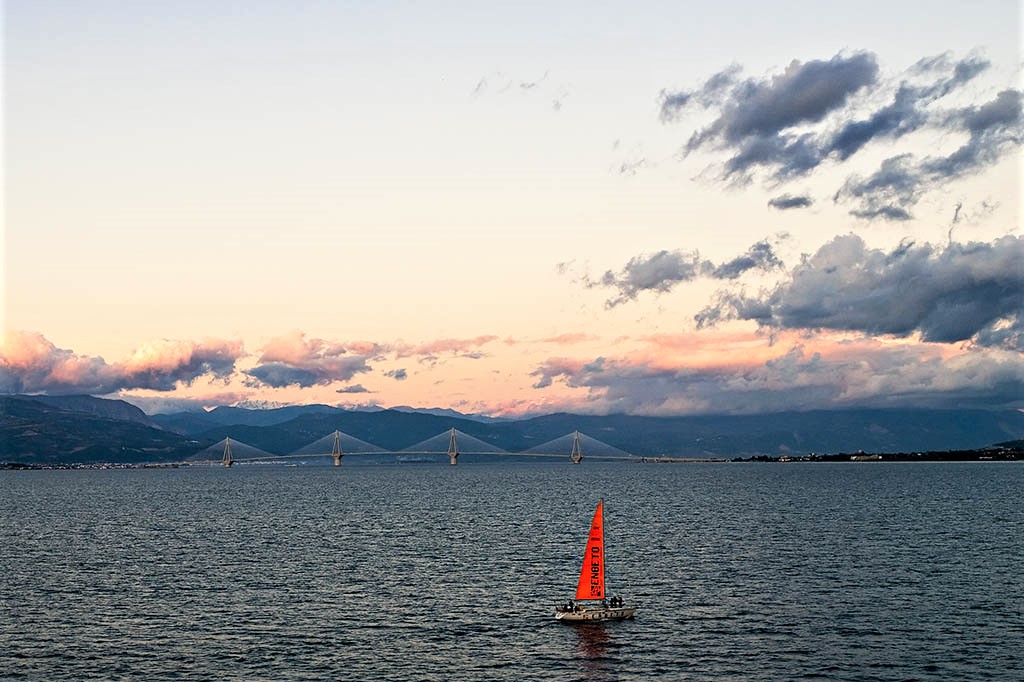
Rio-Antirrio Bridge
Delphi

Thermopylae

There is also a wonderful set of hot springs that were said to have been heated by the venom of the Hydra in the legends of old. After a long day of traveling, I can’t think of anything better.
Pelion

There you have it! No Greece trip is complete without following the Road Trip of the Gods! Where is your favorite spot in Greece? Let us know in the comments below.
Written by Miro Siegel
Written by Miro Siegel